Thriving Through Change: Debating AI And Creativity
“We’re really just hoping to have some meaningful conversations around the challenges that creative professionals are facing today. So, huge shout out to Adobe for being the driver behind this new innovative series.”
The Charlotte chapter of CreativeMornings went big for their Thriving Through Change event to inspire their community to learn about AI from each other.
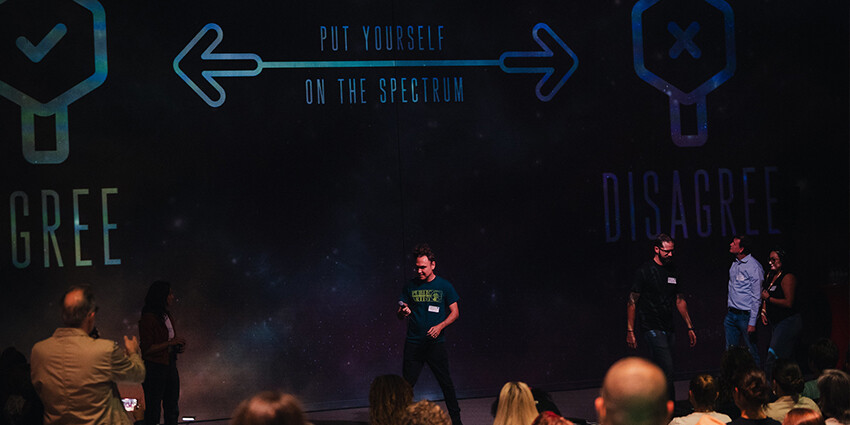
They kicked off the conversation by challenging seven panelists to share their views on questions submitted by the community… by arranging themselves on a giant spectrum projected onto the wall behind them. The energy in the room stayed high as they played a trivia game focused on robots in pop culture. Finally, members of the community voiced their opinions and feelings about AI as well.
The event was part of our special event series called “Thriving Through Change” designed to foster meaningful discussions about the challenges that creative professionals are facing today. Thanks to our Global Partner Adobe, some of our most engaged CreativeMornings chapters around the world are designing interactive event formats that unleash the collective wisdom of our community.
“I think it’s important to point out that we’re all going to have different opinions about AI, obviously, so there’s not going to be one right opinion in this room. We’re not looking to sort of land on what the answer is. We’re looking to jumpstart the conversation and hopefully keep the conversation going as a community.“
The panel featured seven individuals with unique relationships to AI from various creative and technical backgrounds.
- Sydney Stern Miller: A corporate strategist and artist focused on making corporate creativity more human.
- Drew Burdick: Founder of Stealth X, a team of designers and strategists.
- Bart Cant: An AI consultant specializing in optimizing operations in various industries.
- Dr. Derek Wang: Founder of Talk, an AI-powered engagement platform.
- Oliver Lewis: An artist creating interactive public sculptures.
- Elena Kacan: A marketing strategist teaching creatives how to use AI effectively.
- Dr. Hamed Tabkhi: An assistant professor at UNC Charlotte, focusing on machine learning applications for community well-being.

Their friendly debate explored AI’s impact on the value of creative work, ethical considerations, and the need for creative professionals to adapt.
Understanding The History of AI
The panel began with a foundational overview of AI, tracing its history as a decades-old technology that has only recently achieved widespread public attention due to generative AI breakthroughs like ChatGPT. AI is not a new fad but an evolving tool with deep roots encompassing a wide range of applications, including language processing, computer vision, and predictive analytics. The ongoing exponential growth in AI capabilities means creative professionals must choose if they are willing to continuously adapt to an accelerating landscape.

Is AI a Threat or a Tool?
When the panel was asked to agree or disagree with the statement “Using AI tools for creative work diminishes human imagination and originality”, their mixed responses got to the heart of the angst and excitement about AI. One side worried that relying on AI could weaken creative muscles, because creativity requires effort and practice. While the other side countered that AI can enhance creativity by allowing individuals to focus on higher-level ideas rather than mundane tasks.

"If you look at electric guitar, it’s just the electrification that technology adds a new sound. An acoustic guitar couldn’t do it. So, it’s technology augmented music and we all enjoy listening to rock music. So, why don’t we see that AI may enable humans to do another level of creation that we were not able to do before?”
Ethical Considerations
Ethics came up as a widely critical topic, particularly a call for stronger protections for trademarks and privacy. The panel also urged individuals to use AI responsibly, by balancing efficiency gains with a vigilance against addiction, skill erosion, and a loss of human connections.
The Risk of Obsolescence
A significant concern raised was the potential obsolescence of creative professionals who do not adopt AI tools. While some panelists believe that originality will always be valued, others warned that artists risk being outperformed by their peers who leverage AI effectively.
“I don’t necessarily think artists are going to become obsolete, but I do think that if you stay on top of what can be possible, I think you’re way ahead of the game. And I think it just makes you more dynamic and impactful in that way.”
Artists in the room expressed skepticism about AI replacing uniquely human skills like observational humor and emotional connections. Others pointed to AI’s potential as a rehearsal partner or creative collaborator that could refine ideas, test jokes, or edit content.
A consensus emerged that understanding and integrating AI into creative practices could be crucial for future success. Thinking of it as a strategic tool that can augment rather than replace your unique skills and talents might be the key to staying relevant.
“There’s a general statement in business technology that says you you’re not going to lose your job because of AI, but you’re going to lose your job because there’s other people that are going to use AI, right? And my theory is that’s the same for artists, right?“
You can check out more conversations about AI in our Thriving Through Change series hosted by CreativeMornings chapters around the world.
Thriving Through Change is a special event series made possible by CreativeMornings’ global partnership with Adobe.

