The Blogger Union has partnered with CreativeMornings/Miami for a collaborative storytelling marathon. Tune in to read the story of our city told by local creatives, bloggers and entrepreneurs. Each week, a different member of CreativeMornings will take over to post what inspires them about South Florida. Do you want to take over the CreativeMornings/Miami blog and share your take on our community? Email Paola at info@thebloggerunion and we’ll get working on it!
Takeover D & D style! First, it is a privilege to be part of the South Florida Bloggers and even more so to represent them on CreativeMornings. Thank you to CreativeMornings/Miami for this opportunity. The compilation of posts I will share have to do with questions of identity, family, creativity and reflection. In such a frenetic life, I strive to reflect on and possibly create from moments which seem unseen or unacknowledged. Growing up Cuban-Basque American, it’s a mouthful, in Miami seemed matter of fact. I just was; however, now with my daughter I feel like I am growing into myself with intention. Therefore, I share with you reflections on how I am learning to be and to perform my Latinidad and what it means to me as a contemporary woman, mother, friend. Thank you for reading.
About Josie Urbistondo: Hi! My name is Josie. I have been teaching writing and literature and writing myself for about a decade now. Currently, I teach at the University of Miami and mentor high school dual enrollment faculty for Florida International University. It wasn’t until I had my daughter that I yearned for a new space to exercise creative freedom that captured all facets of my identity. Our blog, www.doubtsanddesires.com, I co-author with a dear, long-time friend, Linjen Neogi, became just that. We broker content we find valuable, fun and enriching.
We strive to be a stop for the brainy, hungry, traveling, all around contemporary mami – we hope to provide meditations on life, love, motherhood and the spaces in between. We are here for the constant reader or the casual glance. Working around nap schedules, board meetings and all around beautiful chaos.
This article was originally published on Doubts & Desires.
OMG que voy hacer: Teaching My Daughter Our Culture in a Spanglish Spanish

doubts & desires
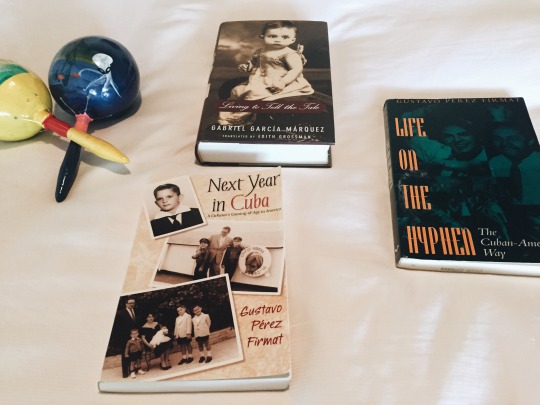
My parents and parents-in-law say, “Tienes que enseñarle español. Aprenderá inglés eventualmente.” (You have to teach her Spanish. She will learn English eventually.) Every time I hear this I think of Gustavo Pérez Firmat’s line, “The fact that I am writing to you in English already falsifies what I wanted to tell you. My subject: how to explain to you that I don’t belong to English though I belong nowhere else.” While in a more optimistic moment, he references the hyphen, how we can belong to multiple historical, cultural and linguistic moments, in this quote he contemplates how we can truly belong to none. Also, Julia Alvarez discusses that in between of language and culture, what Edwidge Danticat calls “the tools I have at my disposal” and “the choice that rises out of the circumstances of our lives.” I love reading these writers because through them I can understand my own identity as inheriting a constant tension second generations negotiate to maintain culture, language, self.
As an adult now and reading scholars like Pérez Firmat and Alvarez-Borland I understand as best as I will ever that my mom and maternal grandparents’ identities, their Cuban selves were inextricably tied to living as much of Cuba within our home as possible. That meant that growing up there was a lot of Celia, frijoles negros (black beans) and dominoes or loteria snapping on the table in the background. (My dad is the odd ball as the only non-Cuban, don’t call him Gallego, Basque of the family.) As a second generation Cuban-Basque-American I am much less invested in keeping an idyllic version of Cuba intact. I grew up with all my Cuban family and an outnumbered Basque man, so I feel very Cuban-American. This has brought me to conversations about authenticity…people questioning my hyphen so to speak - so you can’t really be Cuban or Basque, forget American. I have learned to be unapologetic about who I am and how I choose to hyphenate my identity. I understand now that identity, like gender, is multi-faceted. There is who I think I am, how I perform my identity and how others read/ interpret that identity. (If you ever want to induce a migraine, read Judith Butler’s Gender Trouble…despite the dense material, I understood about 10%, her final chapter on performativity is fantastic.) If one buys into a layered flexibility, that identity is what we practice and not only who I am deep down, there is an inevitable loss of culture. And yes some would optimistically say where there is loss there is invention and creation of something new.
doubts & desires
And here enters my Spanglish, Spanish.
Yes, I do speak to my daughter in Spanish. However, while I consider myself fluent, my fluency is not technical. I can exchange pleasantries in Spanish but can’t explain in a substantive way what I focused on in graduate school. I can give directions and order at an Miami Publix deli but can’t discuss the best ending of a novel EVER - I am totally biased - Garcia Marquez’s One Hundred Years of Solitude (1967). I mean talk about getting meta: a novel written in Spanish which I read in translation in order to connect with (without getting too essentialist) an emotive and incredibly creative latinidad through magical realism.
So for the most part I speak to her in Spanish but then will ‘drop knowledge’ in English. This by the way is the drawback of spending most of my days with 18-20 year olds. Some of the most current phrases will stick, but I tend to use them when they are no longer cool.
My brain functions as a Spanglish domain. There are phrases and emotions one must simply convey in Spanish. Fine, fine, fine they are mostly curse phrases I shouldn’t repeat here! However, my work life, my adult vocabulary is in English. I still listen to Celia and miss my grandmother’s flan and my grandfather’s entrada in loteria. But now we listen to Marc and love my dad’s and mother-in-law’s Michelin rated (in my head) foods. My generation may not keep my mom’s Cuba alive for them or for ourselves, but I hope we can live and make real for the next generation an “ajiaco” of culture where she will feel at home. (Noted Cuban philosopher Fernando Ortiz would be proud!)