
Last month, in December 2017, the global CreativeMornings community was united in discussion on the them of Context. We saw this theme being taken in so many interesting directions by our 180 chapters.
At CreativeMornings Dusseldorf, guest speaker Franz Schuier spoke of his experiences filming at the SISP Kovalam Skate & Surf Club, the Second Chance club, bringing fun and education to members of marginalised communities in Kovalam, India. He spoke of capturing the context, both with its rich culture, and its positive evolution, as opportunities are brought to the people.
CreativeMornings Palermo saw architect and urban planning researcher Davide Leone exploring how games played in social spaces reveal the heritage and culture from which each city context has sprung – thus providing creative inspiration for development, to enhance community connection.

Photo by CMPMO
Former Kentucky Poet Laureate, Frank X Walker, joined CreativeMornings Lexington, discussing the power of words to build context, transforming meaning, and our perceptions of images, messages, symbols, and each other.
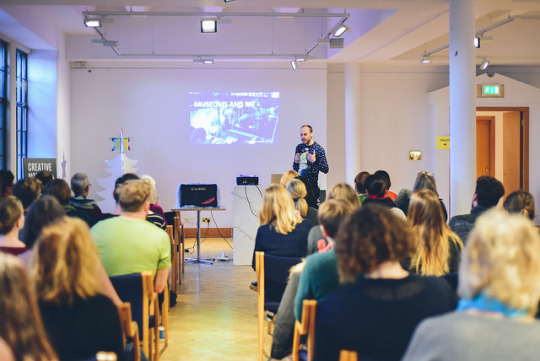
Here at CreativeMornings Edinburgh, we were joined by Rob Cawston, the Head of Digital Media for National Museums Scotland (NMS), where he uses digital tools and content to connect audiences to the museum and its collections.
Photograph by Ellie Morag
In his talk, Rob set us on a journey through museums, galleries, and public spaces, showing the layers of context surrounding each object on display. Given varied experiences and systems of meaning for each individual visitor, interpretations are highly subjective – something which Rob and his co-workers must take into consideration throughout their work.
An additional element of these considerations is the preferred manner of engagement for audiences, which - in our increasingly digitised world – has undergone significant transformation in recent years. New technologies have changed the way we encounter, participate in, and understand our contexts, and those who shape our treasured social spaces, such as museums and galleries, have been hard at work to keep up with the times.
Here are just some of the many ways museum and gallery innovators around the world are reconceptualising spaces for the digital age, providing a wealth of creative inspiration for context and interaction design…
Museum of Ice Cream:

Capturing our thirst for instagramable moments and settings, the Museum of Ice Cream has become somewhat of an icon. It demonstrates the changing ways in which we interact with our environments and, thus, the ever-increasing power of social-media friendly spaces to drive engagement.
British Museum tweets:

To draw the awareness and interest of potential museum-goers, telling the stories of objects and exhibitions has always been key. In this digital age, extending storytelling into our online social spaces has been vital, and institutions such as the British Museum have been getting in on the action. Sharing photos and videos, with carefully chosen words to set the context, a global audience finds new intrigue in history.
Smithsonian Centre for Learning and Digital Access (SCLDA):

“The Learning Lab is one of SCLDA’s next generation of tools designed to make access to and the use of Smithsonian digital assets for learning easier and more effective. Through the Learning Lab and other projects, SCLDA is committed to advancing the use of the Smithsonian’s digital assets in ways that shape the future of learning.
Guided by the Smithsonian’s mission of the increase and diffusion of knowledge, SCLDA was established to re-imagine and ultimately reinvent the way students, teachers, and lifelong learners interact with and use the Smithsonian’s resources in the 21st century. Recognizing most will never visit Smithsonian museums, SCLDA set out to identify how it might best enrich education by making Smithsonian experts and collections accessible to everyone regardless of where they live.”
Virtual Reality - Exhibits Without Borders:
An increasing number of galleries and museums are recognising the value of VR technology, providing widened access, and drawing new crowds:
- The Smithsonian art museum dove into VR at their Renwick Gallery, with Intel’s help – “It’s a glimpse at how virtual reality can let anyone explore distant museums.”

- The Franklin Institute: Virtual Reality at the Musem – “Discover the hidden beauty of the deep sea, fly to the farthest reaches of outer space, take a ride through the complex inner-workings of the human body, and more.”

- The Kremer Museum: Exclusively VR Exhibitions – “Using VR technology, visitors will be able to examine the artworks’ surface and colors up-close, as well as view the reverse of the paintings to explore each work’s unique stamps of provenance.”

- Google Arts & Culture App: 9 Virtual Reality Tours You’ll Love – “…take a virtual tour of the street art scene in Rome; step inside a creation by famous street artist, Insa; or even travel 2,500 years back in time and look around the ancient Greek temple of Zeus.”

In his work, Rob Cawston is busy bringing all this inspiration – and more – into the continuous development of our museums, here in Scotland. As he states, “museums are not for the objects alone…”, they provide an important civic space. Thus, he and his colleagues are working not just to bring exhibits to audiences online, but also to enhance existing physical spaces, ensuring improved accessibility, learning, and community engagement.

Photograph by Ellie Morag
To keep up with Rob, follow him on Twitter at @Cawston and keep an eye on his blog on the official
National Museums Scotland website.