

Farine Five Roses sign, Montreal. Image: Christopher Policarpio.
by Rebecca West
In the lead up to our HERITAGE talk next week with Viviana de Loera, we’re looking into creative Montreal projects that celebrate our cultural heritage. The Montreal Signs Project was a perfect fit, celebrating Montreal’s colourful history of hand-made signs.
The Montreal Signs Project is an ongoing research project dedicated to the exploration of signage in the city of Montréal, through memories, archives, and rescued or donated signs. It was conceived by Matt Soar - Associate Professor of Communication Studies, Concordia University, in collaboration with Nancy Marrelli - Archivist Emerita, Concordia University Archives. The idea for the project came about during the 2007 Logo Cities conference that Matt organized, featuring an exhibit of works focusing on signage and lettering, alongside examples of old and new signs from around the city. Once the conference was over, Matt realized that these beautiful old signs could be be given a new life in Concordia’s recently built Communications & Journalism building, rather than being stuffed away in storage or lost altogether.
We spoke with Matt about his passion for signage, how the Montreal Signs Project is evolving, and the cultural significance of public lettering more broadly.
Is there a favourite sign that marked your childhood?
Growing up in the Midlands in the UK, I always had an interest in graphic design and advertising. There was a particular Perrier commercial that I remember, by the illustrator Gray Joliffe with the tagline “Once you discover Perrier, nothing else will do” (check out a fuzzy version of the animated ad here at 0:57). I really liked the billboard version, and wrote the ad agency asking if I could have a copy. To my surprise, the agency agreed and showed up at the door one day with a massive “48-sheet” billboard poster, that came in 12 parts - each one big enough to cover my bedroom wall. I’ve kept them ever since. My high school stairwells were also decorated with old enamel London Underground signs. When we started the Montreal Signs Project I got in touch trying to find out what happened to them. Unfortunately they seem to have disappeared, which is not so surprising when you consider the market value of some of these objects. They’re often just as likely to end up on eBay as they are in the trash.
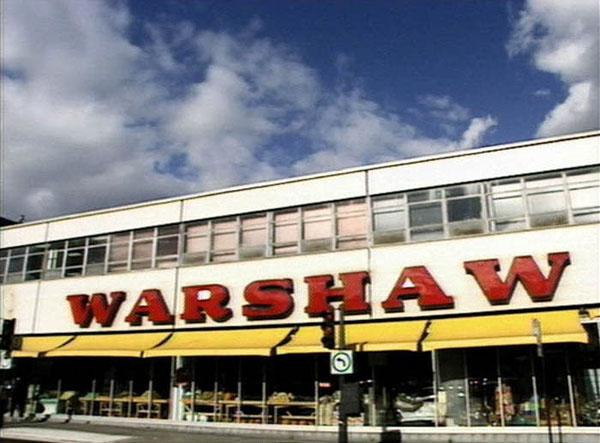
The old Warshaw store on St-Laurent blvd. circa 1999 - now a Pharmaprix. Image: Alex Margineanu from “Warshaw on the Main”

The Warshaw sign’s new home at Concordia. Image: Montreal Signs Project.
You have lived in several cities and countries over the years… London, Vancouver, rural Massachusetts and now Montreal, what would you say is a distinguishing feature of Montreal’s signage, either historically or today?
Public signage can be really jarring, there’s just so much of it. So the first thing I noticed in Montreal is how much of it there is, moving here from a rural setting. I’m not a huge proponent of billboards everywhere, the Logo Cities conference actually aimed in part, to take a critical look at the politics of signs and public space. But discovering Montreal’s signage was also a portal for me, as a new Canadian, to discover and learn about the city’s culture, and what it values - it’s like a fingerprint of the city. You can tell from Montreal’s signs that it was a city of enterprise and diversity, a city of many immigrants. The famous Warshaw grocery sign for example, has an interesting story.
Helen Levy, daughter of the founders Leah and Louis Florkevitz, immigrants from Poland, recounted the story to Canadian Jewish News. In 1935, recently after opening, “… a painter came by and offered to paint a sign on the glass front for $5. He asked what the name was. When my father said Florkevitz, he said how do you spell that? My father said, ‘I can’t read or write, I don’t know. We just came over from ‘Varshaw’ [using the Polish pronunciation], so put that.’” Helen pointed out that wasn’t the correct spelling, but her parents kept it that way because they couldn’t afford to have it changed. When you look into it, every sign has a unique story, that’s part of the fascination.
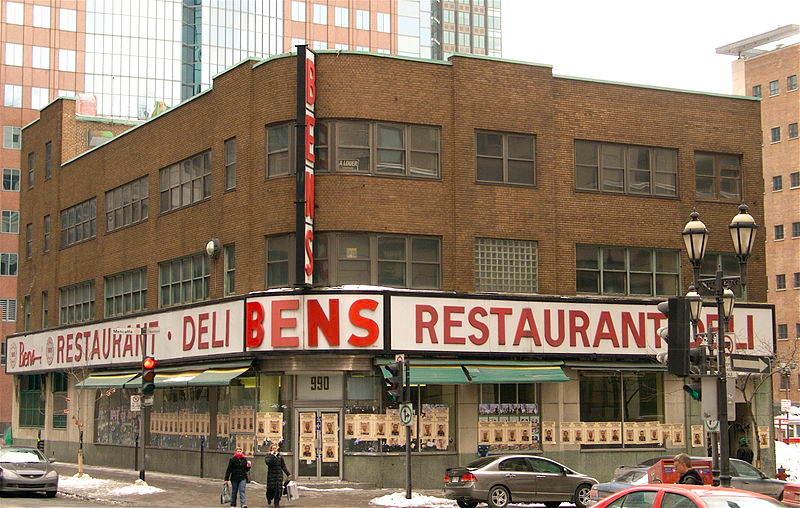
Bens De Luxe Delicatessen & Restaurant, circa 2007. Image: Sandra Cohen-Rose and Colin Rose - Art Deco Montreal.
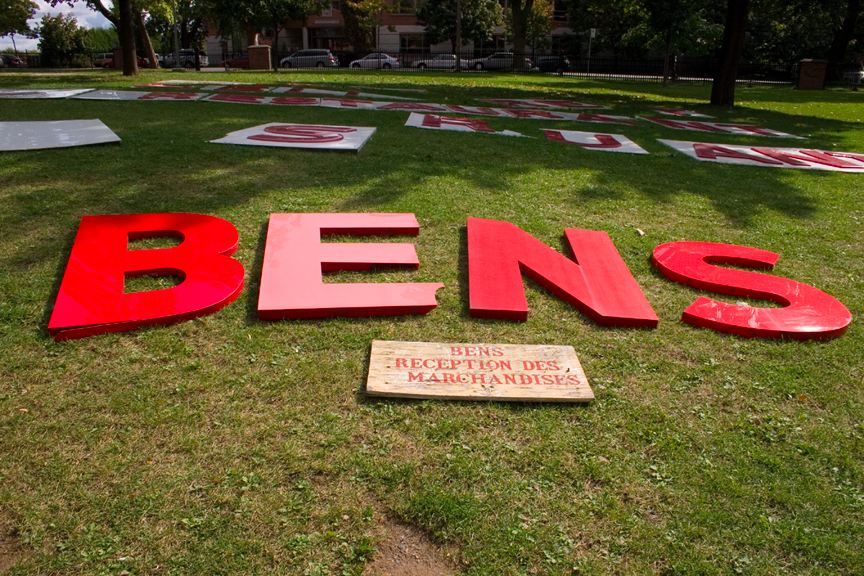
Bens Restaurant sign being picked up from the demolition site and pieced it together temporarily for cataloging by the Montreal Signs Project. Image: Montreal Signs Project.
The Montreal Signs Project is still relatively young, how has it evolved since its launch in 2010?
Well, although it’s a fun project, I feel that we’re 20-30 years too late, so much of Montreal’s iconic hand-made and neon signs have already disappeared. That being said, there is value in displaying these beautiful signs for faculty students and visitors at Concordia. Nancy (Marrelli) was key in deciding that this wasn’t going to be a preservation project, it’s more about giving the signs a final resting place. Although we could expand geographically, we’ve decided that the collection will be limited to Montreal, there is a coherence to the collection that we want to maintain.
Do you see the project evolving in the digital sphere, getting the public involved more broadly?
We are always happy to get tips from the public on signs that may be coming down, or that are in storage. But I don’t really see this evolving into a Tumblr or mobile app, there is so much of that already. There is something nice about the impressive physicality of seeing these massive objects in person. Rather than blending into the city-scape, in the Communications and Journalism building at Concordia, visitors can appreciate the craftsmanship that has gone into each letter. It’s a skill that’s being lost with more generic mass-produced signage these days. There’s Dave Arnold, a.k.a. Mr. Sign who still does beautiful hand-painted signs in Montreal, but it’s most often for a niche high-end market, not your average Mom and Pop shop. Dave is an avid supporter of the Montreal Signs Project, and was actually the one who tipped us off about our recently acquired Sheinart’s sign. [Dave also gave a Creative Mornings talk in Ottawa last year about monetizing his passion for art - check it out!]
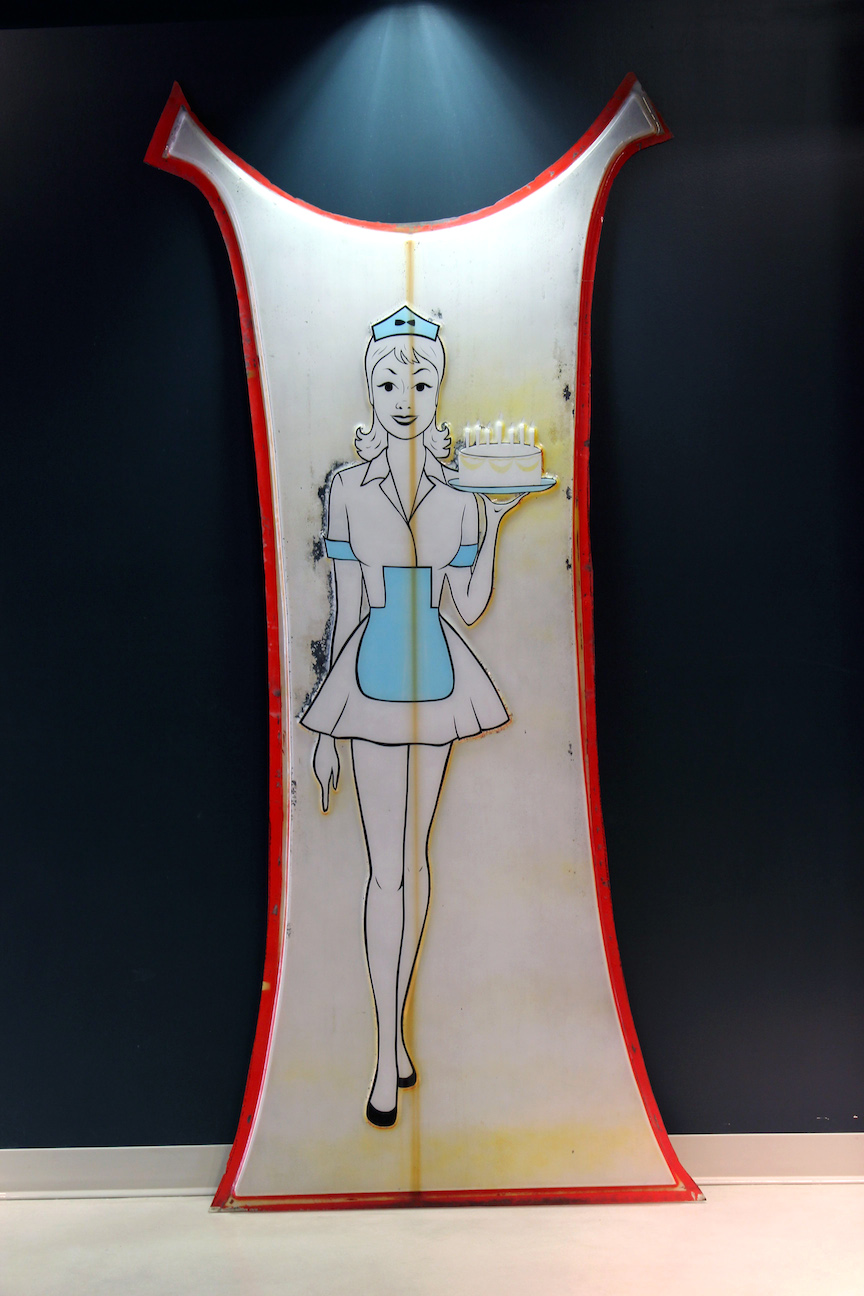
Old Navarino sign from the cafe on Parc Avenue. Image: Montreal Signs Project.
Do you see the preservation of heritage signs as primarily the responsibility of government, businesses, academia or citizens?
Usually when an old sign is coming down, it’s because a business has folded or changed hands. So there is no financial incentive for new owners to keep it. Although in some cases, when a sign’s significance outweighs its original commercial purpose, such as in the case of the iconic Farine Five Roses sign in Montreal, the public does get involved. That sign has been on the top of a waterfront building since 1948. There was a public outcry when the sign was turned off by new owners in 2006 - so they turned it back on within a month. Then more recently, when the brand was acquired by Smucker Foods, there was some uncertainty as to the sign’s fate, and then this past winter it was quietly restored, one letter at a time. It seems it’s here to stay, for another generation at least. So the decision as to whether a sign is preserved or lost is really made on a case by case basis, it often comes down to the people directly involved.
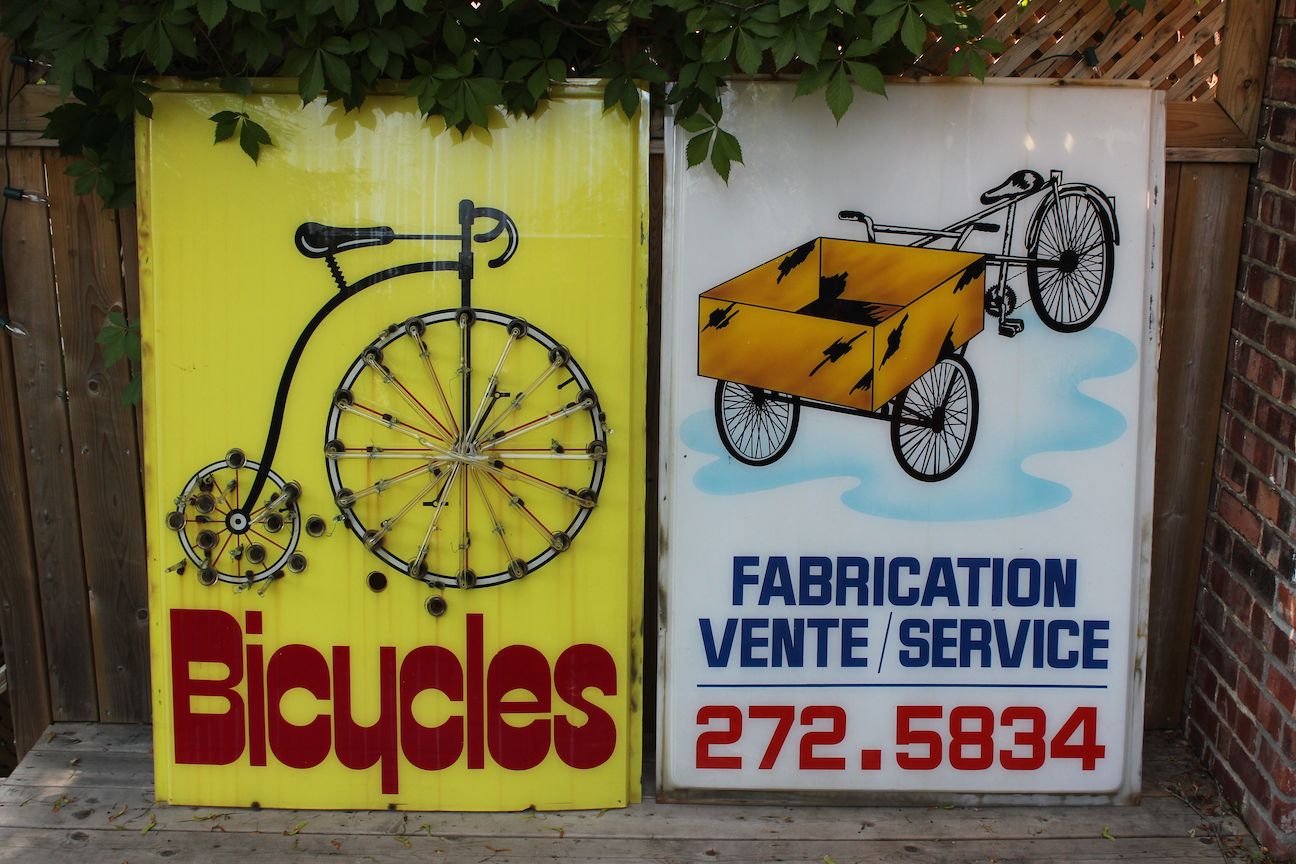
Old Dumoulin Bicycles sign from the shop on Jean-Talon East. Image: Montreal Signs Project.
Are there any upcoming Montreal Signs projects that you’re excited about?
We’ll be installing signs from La Belle Province Meat Co., librairie Guérin, Navarino and Sheinart’s in the coming weeks, it will be great to see these out of storage and displayed for the Concordia community to enjoy.
If you know of any unique Montreal signs wasting away in storage or soon to be taken down, have an interesting sign story to share, or would like to support the Montreal Signs project, they are always happy to hear from you. Private tours of the sign collection can also be arranged, you can always get in touch with them here.