Through the life of Icelandic and Métis heritage, Jónína weaves the story of how she managed to adapt and understand both
Jónína weaves the story of how she managed to adapt and understand both of her family’s backgrounds and how that allowed her to return to University to pursue a degree in Writing. Now collaboration and creativity is in my blood. It enters all I do. It is the doorway to the answers I seek when making decisions, artistic or mundane. How to cross the threshold into that creative space, is at times a mystery. Sometimes prayer and ritual work. At other times it is a walk in the forest where I lay tobacco and give thanks to the Creator and my Ancestors.
About the speaker
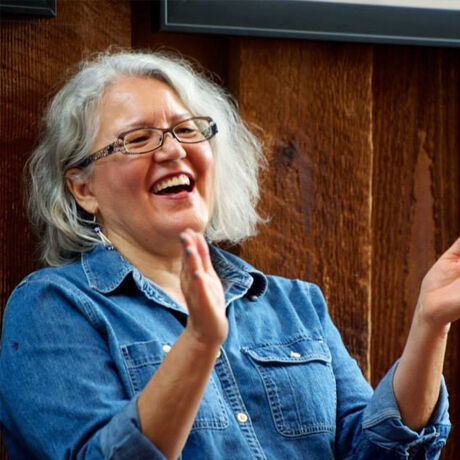
For March's global theme if 'parallel', we are honoured to host the Icelandic and Red River Métis poet Jónína Kirton.
Kirtan was born in Portage la Prairie, Manitoba, Treaty 1, the traditional lands of the Anishinaabe, Cree, Oji-Cree, Dakota, Dene peoples and the homeland of the Métis and she graduated from Simon Fraser University’s Writer’s Studio in 2007. She released her first book, page as bone ~ ink as blood, in 2015 and was sixty-one when she received the 2016 Vancouver’s Mayor’s Arts Award for an Emerging Artist in the Literary Arts category. Her second collection of poetry, An Honest Woman, was a finalist in the 2018 Dorothy Livesay Poetry Prize. Her third book, Standing in a River of Time, released in 2022, merges poetry and lyrical memoir to take us on a journey exposing the intergenerational effects of colonization on her Métis family. She currently lives in New Westminster BC, the unceded territory of the Hul’qumi’num speaking peoples.
Each month we ask our speaker some probing questions to give us a deeper glimpse into their life and relationship with creativity:
How do you define and apply creativity in your life and career?
When young I remember hearing the Navajo teaching that said, we are to “walk in beauty”. Although I am not Navajo this fit with the unspoken message I received from my Métis relatives. Our Ancestors clothing was often decorated with beadwork, sometimes embroidery. Even household objects got a makeover. I have some of my grandmother’s tea towels that she decorated with singing birds made from pieces of cloth that she hand-stitched onto the tea towels. Later in life I learned about the amazing clothing, and tattoos that my Icelandic Ancestors would have worn and that they were also known for their ship building skills. When selecting a tree, they would allow the trees to reveal which one would be best suited. Both the Métis and the Icelanders understood that they were in collaboration with everyone and everything around them.
Collaboration and creativity is in my blood. It enters all I do. It is the doorway to the answers I seek when making decisions, artistic or mundane. How to cross the threshold into that creative space, is at times a mystery. Sometimes prayer and ritual work. At other times it is a walk in the forest where I lay tobacco and give thanks to the Creator and my Ancestors. I do receive answers as I have been blessed with what some call intuition or other ways of knowing. This gift has served me well in life and it is the foundation of my writing. William Stafford’s poem, The Way It Is, says it best. I see this ‘thread,’ as collaboration with something unseen and perhaps unknowable. Within me or is it around me, there is a soft voice that whispers suggestions. These suggestions are like a thread I can choose to follow. It has led me down some interesting paths and at times, people around me did wonder what I was pursuing. Sometimes I did not know myself… all I knew was that I trusted this voice. To this day it has never steered me wrong and on occasion has saved my life.
The Way It Is
There’s a thread you follow. It goes among
things that change. But it doesn’t change.
People wonder about what you are pursuing.
You have to explain about the thread.
But it is hard for others to see.
While you hold it you can’t get lost.
Tragedies happen; people get hurt
or die; and you suffer and get old.
Nothing you do can stop time’s unfolding.
You don’t ever let go of the thread.
— William Stafford, Ask Me: 100 Essential Poems of William Stafford
Where do you find your best creative inspiration or energy?
Inspiration is everywhere. Whether out shopping, sitting in a coffee shop, reading, or at home watching TV, wherever there are words spoken or written, I begin writing in my head. I love to make lists of juicy words, words that feel good in the mouth. Sometimes when I hear people reading poetry I begin moving or deleting words and when listening to a lecture or the news I find myself doing what some call erasure poetry. It’s fun to do and it is all happening so quickly that all I can do is jot down a few words or phrases.
Most of my poems are written by hand. I begin revising while transcribing. At this stage I really enjoy doing deep dives into words and going through what I call my snippet file (the words and phrases I have collected). I will spend hours researching, searching for better ways to say what I want to say in hopes of opening minds and hearts to the issues that some live with.
What’s one piece of creative advice or a tip you wish you’d known as a young person?
I grew up in a hockey family. I was the odd one and creativity was not encouraged. But if it was, I would have wanted someone to tell me to trust my instincts and intuition more. I came to that understanding when I entered recovery in 1986, and prayer and meditation became regular habits. I began to see that I could ask a question and get an answer. This is a great gift to have when writing and that understanding deepened when my beloved writing mentor, Betsy Warland, talked about the need to, “let the narrative lead.” When she said this, a bolt of lightning ran through my body. It was then that I truly understood that my writing was a collaborative process, and that each poem had its own intention; its own agency that I needed to respect.
Who (living or dead) would you most enjoy hearing speak at CreativeMornings?
My dear friend and Elder, Sharon Jinkerson Brass.
What’s the craziest thing you’ve ever done?
I once worked on a psychic phone line offering readings from midnight to 6 am.
If you could open a door and go anywhere, where would that be?
I would visit wherever my mother and brothers are right now. I have lived most of my life without my brothers and still miss them. My mom has been gone for half my life, and I would dearly love a late night tea on the porch with her..
What is the one question we haven’t asked that you want to answer?
Why did it take so long for you to begin writing?
When you get stuck creatively, what is the first thing you do to get unstuck?
I go for a walk and talk to the trees. I pray to the Ancestors and lay tobacco. I ask what is it that I am to be bringing to the page.
Favorite quotes from this talk

Hosted by
Vancouver Art Gallery
Room 4East - 750 Hornby Street
Vancouver, British Columbia Canada V6Z 2H7
Date
Partners
R&M Trade Laminating
Adobe
Indian Residential School Survivors Society