Wouldn’t it be great if creative agencies would *RETHINK* community engagement? (nudge nudge, wink wink) (at Rethink Communications)
All
Talks
Individuals
Chapters

Wouldn’t it be great if creative agencies would *RETHINK* community engagement? (nudge nudge, wink wink) (at Rethink Communications)

Whaaat? Free @Gray_Magazine for all attendees at the next event? Wicked!
A huge thank you to our ongoing support partner Fusion Cine. Whether it’s a special piece of equipment to get an interesting angle or lighting a shot for a particular mood, we can only produce high quality videos of these talks through their generosity, technical prowess, and unwavering support. We readily recommend the folks over at Fusion Cine as a resource for any video production.
Check them out online at www.fusioncine.com

Justin Hart is a postdoctoral fellow in the Collaborative Advanced Robotics and Intelligent Systems (CARIS) Laboratory in the Department of Mechanical Engineering at The University of British Columbia, where he is supervised by Professor Elizabeth Croft. At UBC, his research focuses on enabling humans and robots to effectively communicate and collaborate with each other. As part of this he is working on enabling machines to make inferences and predictions about human behavior, and perform self-reflective reasoning processes in order to effectively collaborate on human-robot collaborative assembly tasks.
Dr. Hart received his Ph.D. in Computer Science from Yale University in November, 2014, where he was advised by Professor Brian Scassellati. For his dissertation, “Robot Self-Modeling,” he developed a system that enabled a robot to make inferences about its body and senses through data sampled during operation. This process is inspired by the process by which children learn about their sensory and physical capabilities and how they are able to interact with the environment; which represents one of the earliest forms of self-awareness to develop during infancy.
Dr. Hart’s work has appeared in New Scientist, BBC News, Business Standard, CBS SmartPlanet, El Mundo, GE’s Focus Forward Films, and at the Ideacity conference. More on Dr. Hart’s work can be found at http://justinhart.net.
1. How do you define creativity and apply it in your career?
There are many different kinds of creativity, but I think that the most honest answer I can give is that creativity is where hard work and imagination come together. People remember the brief flashes of insight that they have, but I think that most people who are successful in their creative endeavors recognize that success in their creative pursuits is the product of the effort and personal investment that they put into their work.In my work, creativity takes a unique shape. I have to know what work has been done on various robotics, human-robot interaction, and artificial intelligence problems so I know what the state of the art is. I then look for the gaps in our understanding. Honestly, when you’ve worked in my field for a while, the gaps jump right out at you. From here, I look to see how I can fill in these gaps, and what my unique take on these problems has to offer. The memorable “flash of insight,” “maybe we can take this approach,” is really somewhere in the middle of the process. Understand what the problem or question is first, have an insight as to a potential approach to its solution, then perform modelling, implementation, experiments to investigate the proposed solution.
2. Where do you find your best creative inspiration?
I have a few responses to this, but I’ll admit that they’re quite opposed. I have a lot of fun with creative inspiration when I have the opportunity to chat with my colleagues about ideas. Sitting in the laboratory, office, or at dinner at a conference and discussing what problems people find interesting provides a really great creative charge. Another time is late at night, in an empty lab, looking at code, designs, and experimental data. Often I’m alone, or with one or two colleagues and we’re just really dedicated to what we’re studying at the moment. Finally, I’m the sort who turns my mind to the next opportunity as soon as I’ve finished a project. I guess that the reason for that is that when I’m actually working on a project, I’ll have an idea for a related project, and then put it onto the back burner. By the time we’re celebrating a job well done, I’m thinking, “Okay, so which back burner idea do I get to pursue now?”
3. What’s the one creative advice or tip you wish you’d known as a young person?
Learn to write well. Learn to express yourself. I heard this advice over and over again when I was young, but it’s true. For many scientists and engineers, the idea that they are passionate about is 100% clear in their head and it’s good, but they have no clear, elegant way to express it. It’s absolutely imperative that people understand why what you are working on is interesting and important. The second part of this is learning to speak well, in terms of public speaking. The third is learning to speak well to your colleagues, one on one or in groups. Finally, you need to be able to speak to people outside of your area of study. Most of us get our charge out of learning things for our own benefit - I know that I do - but our job is to learn things for everyone’s benefit. The ability of our work to benefit others hinges on our ability to communicate it to others. I completely support expanding STEM (Science Technology Engineering and Mathematics) education, but the people who grow up to be scientists, programmers, and engineers need to listen to their educators regarding how very important it is that they learn to write well.
4. Who would you like to hear speak at CreativeMornings?
I have many colleagues who would do just an amazing job at this, but when I saw this question, a couple of friends of mine leaped into my mind, because I know that they’d have fun with it and speak well to the Creative Mornings audience. Their names are Matthew Krause and Matthew Johnson, and they did their PhDs alongside me, but in the neuroscience program at Yale. They have a science podcast called the Super Science Happy Hour with Matt and Matt, and it’s just fantastic. They remind me of people who, when I was very young, inspired me to do what I do now.
5. Where was the last place that you travelled?
My last trip out of Vancouver was to the 2015 ACM/IEEE Conference on Human Robot Interaction, better known as HRI. HRI is a really excellent conference where many of the top projects in Human-Robot Interaction are presented. It’s also a community that I’ve been active in for many years, so I have the opportunity to reconnect with many friends and colleagues. The conference was held in Portland, Oregon. Conferences are often held in interesting places, and it is fun to see a new place, but, honestly, the things that I remember most from conferences are the conversations that I have, the talks that I see, and the connections that I make.
6. How would you describe what you do in a single sentence to a stranger?
I build robots in order to understand how humans think and how they communicate with each other.
Our March speaker Martin Jackson is so humble and got the crowd really fired up about INK! (at SFU Woodward’s)

Danielle Krysa has a BFA in Visual Arts, and a post-grad in Design. She has worked as a graphic designer and Creative Director for 15 years, and is the writer / curator behind the contemporary art site, The Jealous Curator (launched 2009). Danielle writes daily posts showcasing artwork from around the world, has written articles for several magazines including Anthology, and Frankie, and in 2014 she published two books, both with Chronicle Books, titled “Creative Block” and “Collage”. Danielle has just started writing her third book which will be released Fall 2016. Danielle has curated art shows in Washington DC, Vancouver Canada, Chattanooga TN, Los Angeles, and San Francisco. She has also had the great pleasure of being a guest speaker at PIXAR, and was recently featured in several video segments on oprah.com. The Jealous Curator has been featured by Oprah Magazine, The Huffington Post, Brain Pickings, Sunset Magazine, Frankie Magazine, InsideOut Magazine, Flow Magazine, The Vancouver Sun, Apartment Therapy, and Glamour Paris.
How do you define creativity and apply it in your career?
This is a strangely hard question to answer! I suppose, to me, creativity means looking at the world in your own unique way, and then being able to make your ideas into reality in whichever form works for you… visual art, design, craft, writing, music, etc. I have a BFA followed by a design degree so I’ve had a creative career since my early 20s. When I got my first design job out of college, I can clearly remember thinking how insane it was that I just got to make stuff all day long… and they paid me!? Granted, a creative career can be pretty exhausting on the days when there are NO ideas to turn into reality, but hopefully those days are few and far between!
Where do you find your best creative inspiration?
Thrift shops.
What’s the one creative advice or tip you wish you’d known as a young person?
I wish I’d known that everyone has an inner critic. I truly thought I was the only one that heard that mean little voice, and I let it stop me for a really long time. If I’d known that every creative person hears it from time to time (or all the time!) I would have cut myself some slack.
Who would you like to hear speak at CreativeMornings?
Mary-Jo Dionne
How does your life and career compare to what you envisioned for your future when you were a sixth grader?
My plan had been to be a back-up dancer for Janet Jackson. I’m still waiting for that to work out.
When you get stuck creatively, what is the first thing you do to get unstuck?
Eat chips. But right after that, I cut things up. Whatever I’m working on that isn’t working gets chopped up, moved around and transformed into something completely different. It usually works.
What is the one movie or book every creative must see/read?
I love Wayne White’s documentary, “Beauty is Embarrassing”
Martin Jackson, professional calligrapher lives peacefully in Vancouver and has run his own design studio here for almost half a century! We want to give him a standing ovation already. He is one of Canada’s foremost calligraphers. He studied the manuscripts of early scribes and has made a career of travelling the globe sharing his deep passion and knowledge with students. He has created commissioned pieces - text, graphics, logos and fine art for many clients who appreciate his love of the craft. He shares with us ‘I’m really no different than a plumber or carpenter, I can’t be too Artsy!’ His sense of humour and quickness lights us up. He has gifted the Prince and Princess of Wales and Pope John Paul II in the 1980’s pieces of his original work. Martin shared with us his deep belief that “for handwriting one of the greatest disasters of all time was the introduction of the ballpoint pen, all thanks to Laszlo Biro who invented it, ever after we were all writing in a scrawly monoline ‘style.’” Creative Mornings this March is going to be one to remember. Bring your favourite pen! Take notes. Think about it. Here’s a fun fact to get you amped up for the morning of Friday March 6th, Martin produced all the calligraphy for the wedding reception of Bill Gates. Yes. He’s a rare one.
 Martin Jackson was born in Sheffield, England, and emigrated to Canada in 1966.
He has almost 60 years of experience as a graphic designer and calligrapher, and for over 46 years has run his own design studio in Vancouver.
As one of Canada’s foremost calligraphers he has lectured and taught across Canada, the US, Japan and Europe.
Among his many commissions are pieces for their Royal Highnesses the Prince and Princess of Wales, and for the visit of Pope John Paul II in 1984. He also produced the calligraphy for the wedding reception of Bill Gates.
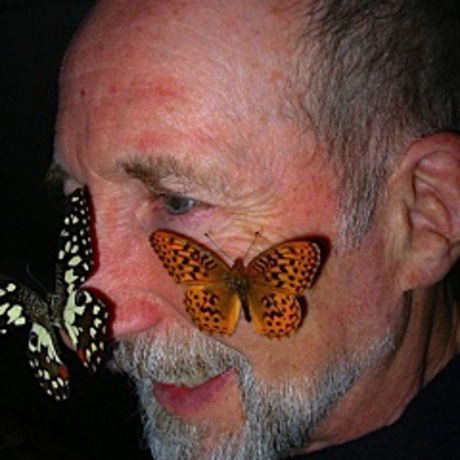
When not working on his calligraphy he is an avid nordic skier, and he collects and rears moths and butterflies.
How do you define creativity and apply it in your career?
For me it is always the challenge of meeting the clients expectations. Usually I am presented with raw text, and working with this I have to create something which must not only be legible, but also something that is visually beautiful to amaze and delight them, and also on time and on budget. I must never forget that I am just offering my services, really no different from a plumber or a carpenter etc., I can’t be too ‘Artsy’!
Where do you find your best creative inspiration?
From studying early manuscripts. There is so much to be learned from the early scribes who produced such beautiful work using the most simple tools and materials.
What’s the one creative advice or tip you wish you’d known as a young person?
Not to get too carried away with trends and fads, they soon fade, it is not good to always be ‘one of the herd’. If you have all the essential basic design skills it is better to develop your own style, it just takes time.
Who would you like to hear speak at CreativeMornings?
Crispin Elsted of Barbarian Press.
If you had a magic wand, where would you be in five years?
Alive, and still able to do calligraphy!
Why is it important we don’t lose the skill of writing things by hand?
Handwriting can be so beautiful, it is part of who we are, it can say so much about our personality.
When you check your mail box there is something very special about finding an item addressed to you that has been written by hand, it makes an immediate contact somewhere deep within us. Part of this is because you realize that the person writing to you was also thinking only of you, and will have taken more care over the choice of words, and spelling etc. I can guarantee you will open this item first. No matter what font you use for an email it will never match the magic of hand writing, and how could anyone possibly think of writing a love letter using a computer!
It is not by accident that many of the other items in your mailbox will have used fonts that look like they are handwritten, hoping you will be fooled into thinking that “dear householder’ really is meant just for you, right?
Even those who say their handwriting is awful would be surprised at how much improved their writing would be if they used a Fountain Pen. The feel of a fountain pen in your fingers and seeing the flow of the ink and hearing the sound of the nib on good paper is quite sensuous. For handwriting one of the greatest disasters of all time was the introduction of the ballpoint pen, all thanks to Laszlo Biro who invented it, ever after we were all writing in a scrawly monoline ‘style’.
How sad that so few people can find the time to ‘put pen to paper’, I don’t think there is yet an ‘app’ to solve this.
Nicole Bridger speaks on Creative Climate and Mindfulness this Friday for our February edition of Creative Mornings Vancouver. What does creative climate mean? This teaser video is a glimpse into Bridger’s creativity on demand style and how she manages stress in an awesomely authentic way. She’s got the tools to cultivate strength through mindfulness and her daily practice include meditating for 30 minutes and working through interruption. This socially conscious Vancouver clothing designer brings her honest truth to Creative Mornings this Friday, February 6th. We can’t wait to snag all her insights and kickstart the weekend with a healthy way of looking at change and relaxing one of the biggest words of our time, climate.
Pete Dupuis, from CEO and President of S&P Real Estate Corporation to entrepreneur for social change discusses World Housing on the topic of ‘Ugly.’ Inspired by TOMS shoes founder, Blake Mycoskie on a flight from Los Angeles to Vancouver in 2009, Pete spent the next three years studying social entrepreneurship, slum housing and landfill communities. In January 2013, World Housing, a housing supply program through a first world one-for-one real estate gifting model is born.